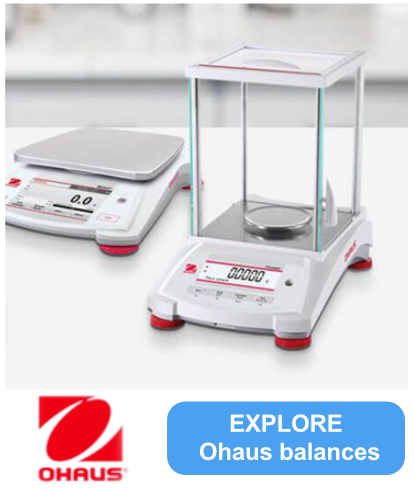
Ohaus balances
WE ARE OHAUS AUTHORIZED DISTRIBUTOR
OFFERING TECH SUPPORT & CALIBRATION SERVICES • EXPERT PROJECT GUIDANCE
OHAUS balances are recognized worldwide for their precision, durability, and advanced weighing technology, making them a trusted choice across laboratory, industrial, education, and commercial environments.
Manufactured by OHAUS Corporation, these instruments are designed to deliver fast, accurate, and repeatable results, even in demanding applications. With a comprehensive portfolio that includes analytical, precision, portable, and industrial balances, OHAUS provides solutions tailored to virtually any weighing requirement. Their balances feature automatic internal calibration, high-speed stabilization, intuitive touchscreen interfaces, and advanced connectivity options for seamless data management.
Built for Long-Lasting Reliability
Ohaus balances are known to withstand gruelling workloads, offering durable construction and consistent results in demanding environments.
Intuitive Operation, Faster Results
Ohaus instruments feature user-friendly interfaces, clear displays, and streamlined workflows that help reduce training time and improve productivity across laboratory and quality control applications.
COMPARE OHAUS BALANCE SERIES
| OHAUS SERIES | BEST SUITED FOR | WEIGHING CLASS | KEY ADVANTAGE | CHOOSE IT WHEN |
|---|---|---|---|---|
| Explorer | Research, pharmaceutical, advanced QC and demanding laboratory workflows | Semi-micro, analytical and precision | Premium laboratory platform with advanced weighing, workflow and data-management capabilities | You need high-performance weighing plus advanced applications, connectivity and laboratory workflow features |
| Adventurer | Routine laboratory analysis, formulation and quality control | Analytical and precision | Combines strong laboratory performance with a user-friendly feature set | You need a capable laboratory balance without requiring the full advanced platform of Explorer |
| Pioneer | Routine laboratory weighing, education and general quality control | Analytical and precision | Practical laboratory weighing with less complexity than premium balance platforms | Reliable routine weighing and value are more important than advanced workflow features |
| Scout | Education, field work and general portable weighing | Portable precision | Compact design for convenient weighing where portability and simplicity matter | You need a small balance that can be moved easily between work areas |
| Navigator | Production, packaging, inventory and general-purpose weighing | Compact / portable | Fast, straightforward operation for frequent everyday weighing tasks | You need a versatile compact scale for routine commercial or industrial work |
| Ranger | Production, checkweighing, counting and industrial processes | Compact industrial | Industrial-oriented design for repetitive production and process weighing | The scale will be used primarily in production rather than on a laboratory bench |
| Defender | Manufacturing, receiving, shipping and higher-capacity industrial weighing | Bench / industrial | Higher capacities and rugged configurations for industrial weighing | You need to weigh larger containers, materials or production loads |
| MB Series | Food, pharmaceutical, materials and quality-control moisture testing | Moisture analyzer | Combines weighing and controlled heating to determine moisture content | Your primary measurement is moisture content rather than sample mass alone |


Analytical Balances
OHAUS analytical balances are built for high-precision laboratory applications requiring extremely fine measurements. Equipped with draft shields and advanced calibration systems, these balances ensure stable and accurate readings even in controlled environments. They are widely used in pharmaceutical, chemical, and research laboratories where precise measurement is critical.


Compact/portable balances
OHAUS compact balances are lightweight, portable solutions designed for quick and simple weighing tasks. These models are ideal for classrooms, fieldwork, and mobile applications where space and convenience are key. They provide dependable performance with intuitive operation, making them suitable for basic weighing without the need for advanced laboratory features


Bench & Industrial Scales
OHAUS bench and industrial scales are designed for higher-capacity weighing in production, shipping, and warehouse environments. These models are built to handle bulk materials and large containers while maintaining reliable accuracy. Features such as counting, checkweighing, and rugged construction make them ideal for logistics, packaging, and industrial operations.


Moisture Analyzers
OHAUS moisture analyzers combine precision weighing with controlled heating to determine moisture content quickly and accurately. These instruments are widely used in food processing, pharmaceuticals, and materials testing where moisture levels directly affect product quality. Automated drying and measurement processes provide fast and reliable results.


Advisers with extensive professional experience
knowledgeable in laboratory processes 1-800-463-4363
Q&A
What is the difference between Ohaus Explorer and Pioneer balances?
Explorer balances represent Ohaus's premium laboratory platform, offering advanced features such as customizable user management, extensive application modes, multiple calibration options, enhanced connectivity, and configurable workflow settings for regulated or high-throughput environments. Many Explorer models also offer advanced draft shield designs and faster stabilization times, helping improve productivity and measurement consistency.
Pioneer balances are designed as a practical and cost-effective solution for routine laboratory weighing. They provide reliable performance, internal calibration on selected models, USB connectivity, a second-line display, and static-removal features on many versions. Pioneer balances are commonly used in educational laboratories, quality-control departments, research facilities, and general industrial applications where dependable weighing performance is required without the advanced workflow tools found on Explorer models.
| Application | Recommended Series | Reason |
|---|---|---|
| University teaching laboratory | Pioneer | Reliable, economical, easy to operate |
| Routine quality-control weighing | Pioneer | Strong performance without unnecessary complexity |
| Pharmaceutical laboratory | Explorer | Advanced user management and documentation features |
| Research laboratory with multiple users | Explorer | Greater customization and workflow control |
| Frequent analytical weighing | Explorer | Faster stabilization and advanced operating features |
| General industrial laboratory | Pioneer | Excellent balance between performance and cost |
How often should an Ohaus balance be calibrated in a quality-controlled environment?
In a quality-controlled environment, calibration frequency should be based on risk, weighing tolerance, usage intensity, and the requirements of the laboratory's quality system rather than on a fixed universal schedule. At minimum, a balance should be calibrated or verified after installation, after relocation, following maintenance or repair, and whenever significant environmental changes occur, such as fluctuations in temperature, humidity, or vibration.
Many laboratories perform daily or pre-use performance checks using certified test weights and schedule formal calibration annually or semi-annually. Facilities operating under stricter quality standards, such as pharmaceutical, biotechnology, or accredited testing laboratories, may require more frequent verification and documentation.
Balances equipped with internal calibration features can automatically compensate for temperature changes and help maintain performance between service intervals. However, internal calibration does not replace a documented calibration program using traceable standards when regulatory compliance, audit readiness, or quality certification is required.
The most effective approach is to establish a written calibration procedure that defines test weights, acceptance limits, verification frequency, corrective actions, and record-keeping requirements.
| Environment | Typical Verification Frequency | Typical Formal Calibration Frequency | Reason |
|---|---|---|---|
| High school or university laboratory | Monthly or before critical experiments | Annually | Moderate accuracy requirements and lower daily usage |
| Food production quality-control lab | Daily check with certified weights | Every 6–12 months | Regular product testing and traceability requirements |
| Pharmaceutical manufacturing facility | Before each shift or daily | Every 3–6 months or per SOP | Strict compliance and audit requirements |
| Research laboratory | Daily or weekly depending on use | Annually or semi-annually | High-value samples and repeatable results required |
| Industrial production environment | Daily verification | Every 6–12 months | Heavy use and exposure to changing conditions |
| Calibration or metrology laboratory | Daily verification with multiple test weights | According to accreditation requirements | Extremely tight measurement tolerances |
Factors That May Require More Frequent Calibration
- Frequent balance use throughout the day
- Very small sample weights (milligram or microgram measurements)
- Regulatory requirements such as ISO, GMP, GLP, or FDA compliance
- Temperature, humidity, or vibration changes
- Relocation of the balance
- Failed performance verification checks
- Critical quality-control or research applications
In practice, many quality-controlled facilities follow a layered approach: daily verification, internal calibration as needed, and scheduled annual or semi-annual traceable calibration to maintain confidence in measurement results and satisfy audit requirements.
Why do so many laboratories standardize on Ohaus balances?
Many laboratories standardize on Ohaus balances because the company offers a complete weighing ecosystem that spans analytical balances, precision balances, moisture analyzers, bench scales, counting scales, and industrial weighing equipment. This broad product range allows organizations to use a single manufacturer across multiple departments while selecting models that are tailored to each application.
Standardizing on one brand can simplify employee training, calibration procedures, software integration, accessory compatibility, spare parts management, and service support. Users who are already familiar with one Ohaus instrument can often transition easily to another, reducing training time and minimizing operating errors.
Ohaus balances are also known for combining user-friendly operation with durable construction and reliable performance. This makes them suitable for a wide range of environments, including research laboratories, educational institutions, manufacturing facilities, quality-control departments, and production areas where instruments may be used by multiple operators throughout the day.
For purchasing and quality managers, the advantage is often not a single balance model but the ability to support many weighing applications through a consistent platform with familiar interfaces, standardized procedures, and centralized supplier support.
| Organization Type | Why Ohaus Is Often Chosen |
|---|---|
| University science department | Students can learn on similar interfaces across multiple laboratories and weighing applications. |
| Food manufacturing plant | Quality-control, formulation, and receiving departments can use compatible weighing equipment from one supplier. |
| Pharmaceutical laboratory | Standardized procedures, training, and documentation are easier to maintain across multiple balance types. |
| Contract testing laboratory | Consistent operation helps reduce training requirements and improve workflow efficiency. |
| Industrial production facility | Bench scales, precision balances, and counting scales can all be sourced from the same manufacturer. |
| Multi-site organization | Simplifies purchasing, calibration scheduling, service agreements, and spare parts management across locations. |
How can you future-proof a laboratory balance purchase?
Future-proofing starts by selecting a weighing platform that can support both current and future laboratory requirements. While a laboratory may initially need only routine weighing, future applications may demand higher readability, internal calibration, data connectivity, user management features, density determination, moisture analysis, or integration with printers, LIMS software, and laboratory workflows.
How much does vibration affect weighing accuracy?
Vibration can significantly affect weighing accuracy, particularly when using analytical balances and other high-readability instruments. Even if a balance is capable of displaying measurements to 0.1 mg or finer, external vibration can prevent the weighing system from reaching a stable result.
The impact of vibration may appear in several ways, including fluctuating readings, extended stabilization times, inconsistent repeatability, or difficulty obtaining the same measurement when weighing the same sample multiple times. In severe cases, vibration can contribute more measurement uncertainty than the balance's stated readability.
Modern balances, including premium models from Ohaus, often incorporate digital filtering, stability algorithms, and improved mechanical designs to help reduce the effects of minor environmental disturbances. However, no balance can completely eliminate the influence of a poor installation environment.
For optimal performance, balances should be installed on a rigid, vibration-resistant surface away from equipment that generates mechanical movement, such as centrifuges, pumps, compressors, mixers, HVAC systems, automatic doors, or heavily trafficked walkways.
What environmental factors influence measurement results?
Air currents, temperature gradients, static electricity, and humidity changes can influence results. Air movement can push on the sample or weighing pan, which is why analytical balances normally use a draft shield. Temperature changes can create convection currents and cause the balance or sample to stabilize slowly. Humidity can affect hygroscopic samples, static behavior, and some materials being weighed. For Ohaus users, the practical answer is to combine good instrument selection with good weighing practice: allow the balance to warm up, use the draft shield correctly, avoid placing balances near vents or doors, level the instrument, and let samples reach room temperature before weighing. Environmental control often improves results more than upgrading to a higher-resolution model.
Have more questions? Drop us a line at info@canadabalances.ca