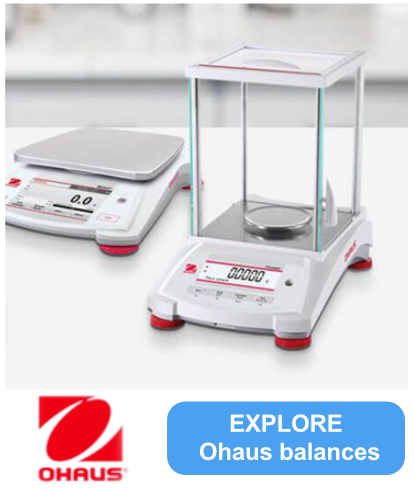
A&D balances
WE ARE A&D AUTHORIZED DISTRIBUTOR
OFFERING TECH SUPPORT & CALIBRATION SERVICES • EXPERT PROJECT GUIDANCE
A&D balances are trusted worldwide for their precision, reliability, and advanced weighing technology, making them ideal for laboratories, industrial applications, and quality control environments.
These balances combine cutting-edge features such as internal calibration, high-speed response, and user-friendly interfaces to ensure accurate and consistent results. Many A&D instruments incorporate advanced data communication, statistical functions, and compliance-oriented features that support modern laboratory workflows and quality systems.
COMPARE A&D BALANCE SERIES
| A&D SERIES | BEST SUITED FOR | AVAILABLE READABILITY | CALIBRATION | CHOOSE IT WHEN |
|---|---|---|---|---|
| BM Series | Research and very high-resolution laboratory weighing | 0.001 mg to 0.1 mg | Model dependent | You need micro, semi-micro or analytical readability for very small mass measurements |
| Borealis BA Series | Advanced micro and semi-micro laboratory weighing | Down to 0.001 mg | Model dependent | You need current-generation micro or semi-micro performance, including dual-range options |
| Newton EJ Series | Education, portable laboratory work and routine weighing | 0.0002 g to 0.1 g | External | You want a compact, portable balance across a broad range of capacities and resolutions |
| Everest EK / EW Series | Routine weighing, production and portable applications | 0.01 g to 1 g depending on model and range | External | You need a compact balance, including Legal for Trade or intrinsically safe options on selected models |
| FX-i Series | Routine laboratory and precision weighing | 0.001 g or 0.01 g | External | You need a compact precision balance and prefer external calibration; IP65 and approved versions are available on selected models |
| FZ-i Series | Laboratory and quality-control precision weighing | 0.001 g or 0.01 g | Internal | You want the precision range of the FX/FZ platform with convenient internal calibration |
| Apollo GF Series | Advanced laboratory, quality-control and precision weighing | 0.1 mg to 0.1 g depending on model | External | You want the versatile Apollo platform with external calibration, including analytical, precision, high-capacity and approved options |
| Apollo GX Series | Advanced laboratory, industrial and high-capacity precision weighing | 0.1 mg to 1 g depending on model | Internal | You want Apollo performance with internal calibration and an exceptionally broad choice of capacities |
| Phoenix GH Series | Analytical and semi-micro laboratory weighing | 0.01 mg or 0.1 mg | Internal | You need an analytical balance with internal calibration, including dual-range semi-micro models |
| Gemini GR Series | Routine analytical and semi-micro laboratory weighing | 0.01 mg or 0.1 mg | Internal | You need a dedicated analytical balance with internal calibration and semi-micro capability on selected models |
| Galaxy HR-A / HR-AZ Series | Routine analytical laboratory weighing | 0.1 mg | External (HR-A) / Internal (HR-AZ) | You need a straightforward 0.1 mg analytical balance and want to choose between external and internal calibration |


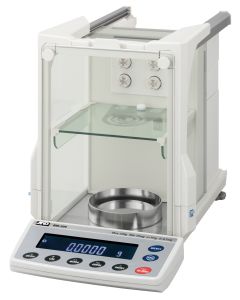
A&D - High-Resolution / Advanced Precision
A&D high-resolution balances are designed for applications where greater precision is required across higher capacities. These models bridge the gap between analytical and industrial systems, making them ideal for formulation, density testing, and advanced laboratory workflows. Differences between models include capacity, resolution, and calibration systems, allowing users to achieve consistent results even with heavier samples.


Advisers with extensive professional experience
knowledgeable in laboratory processes 1-800-463-4363
Q&A
How important is repeatability compared to readability when selecting a balance?
Repeatability is often more important than readability when the goal is reliable decision-making. Readability tells you the smallest increment displayed by the balance, while repeatability indicates how closely the balance can reproduce the same result when weighing the same sample multiple times.
Why can two balances with the same readability produce different results?
Readability is only the smallest displayed increment; it does not describe the overall quality of a measurement. Two balances with the same readability can differ significantly in repeatability, linearity, stability, and their ability to maintain consistent results under real operating conditions. For example, two balances may both display 0.1 mg increments, but one may produce more consistent results when weighing the same sample repeatedly.
How can weighing data be integrated into laboratory quality systems?
In a quality system, the goal is to connect the measurement to the sample, operator, date, time, method, and instrument identity. Manually copying weights into notebooks or spreadsheets creates transcription risk and weakens traceability. Weighing data can therefore be integrated into quality systems through direct output to printers, computers, LIMS, or data collection software.
What factors contribute most to long-term weighing consistency?
Even a well-designed balance can perform poorly if it is placed near air vents, doors, vibrating benches, or heat sources. Internal calibration can help compensate for environmental changes, but it should be combined with routine checks and documented procedures.
What balance features are most important in GMP and ISO-controlled environments?
In GMP and ISO-controlled environments, traceability is often just as important as measurement accuracy. Useful features include internal calibration, balance identification, data output, and integration with printers, computers, or LIMS. The laboratory must define SOPs, acceptance criteria, calibration intervals, minimum weight requirements, cleaning procedures, and record retention. The best instrument is the one that makes those procedures easier to follow consistently.
What causes weighing drift, and how can it be minimized?
Weighing drift is a gradual change in the displayed value over time. It can be caused by temperature changes, air currents, static electricity, vibration, sample evaporation or moisture absorption, unstable containers, insufficient warm-up time, poor leveling, contamination, or sensitivity drift in the instrument. Most drift problems originate from environmental conditions rather than the balance itself. If drift persists after environmental factors have been controlled, the balance may require cleaning, maintenance, or service.
What is measurement uncertainty, and why does it matter?
Measurement uncertainty is an estimate of how much the true value may differ from the reported measurement. It combines multiple sources of variation, including repeatability, calibration uncertainty, environmental influences, linearity error, and sample-handling effects. Uncertainty does not mean a measurement is wrong; it quantifies how much confidence can be placed in the result. A common misconception is that a balance with finer readability automatically produces more reliable measurements. In reality, a balance may display 0.1 mg increments while the overall measurement uncertainty remains much larger due to environmental conditions or limitations of the weighing process. Bottom line: Readability determines what the balance can display, while measurement uncertainty determines how much confidence can be placed in the result.
What is the difference between readability, repeatability, and measurement uncertainty?
Readability is the smallest increment displayed by the balance, such as 0.1 mg or 0.001 g. Repeatability is the balance's ability to produce the same result when the same load is weighed repeatedly under the same conditions. Measurement uncertainty is broader: it considers repeatability along with other sources of potential error, including environmental influences, linearity, sensitivity, calibration, and the weighing method itself. This distinction becomes important when working with very small samples. A balance may display 0.1 mg increments, but if uncertainty is large relative to the sample mass, the measurement may not be reliable enough for the intended purpose.
Real-Life Examples
Example 1: High Readability, Poor Repeatability
A balance displays weights to 0.1 mg, but a 10 g sample weighs:
- 10.0000 g
- 10.0005 g
- 9.9997 g
- 10.0003 g
The balance has excellent readability, but the results are not perfectly repeatable. The extra digits may create a false impression of precision.
Example 2: Lower Readability, Better Repeatability
A balance displays weights only to 0.001 g, but a 10 g sample repeatedly weighs:
- 10.000 g
- 10.000 g
- 10.001 g
- 10.000 g
Although fewer digits are displayed, the results are more consistent. For many quality-control applications, this balance may be the better measuring instrument.
Example 3: Readability vs. Measurement Uncertainty
A balance displays 0.1 mg increments and is used to weigh a 5 mg sample.
The display may show:
- 5.0 mg
- 5.1 mg
- 5.0 mg
However, if the overall measurement uncertainty is ±0.3 mg (due to repeatability, calibration, temperature changes, vibration, static electricity, and other sources of variation), the true value could be significantly different from the displayed reading. The balance can display the number, but confidence in the measurement is limited.
Example 4: Why Small Samples Are Challenging
A laboratory weighs a 100 g sample on a balance with an uncertainty of ±1 mg. The uncertainty is insignificant relative to the sample mass.
The same balance is then used to weigh a 2 mg sample. The uncertainty now represents a large percentage of the sample weight and may no longer be acceptable for the procedure.
Readability determines what the balance can display, repeatability determines how consistently it measures, and measurement uncertainty determines whether the measurement is reliable enough for the intended application.
This is one of the few questions where examples are arguably more valuable than the definitions themselves. A reader may forget the terminology, but they'll remember that a balance can display impressive digits without necessarily producing reliable measurements.
Have more questions? Drop us a line info@canadabalances.ca